Lola Rennt (official English title: Run Lola Run) is an award-winning movie is about a young couple in Germany caught in various dilemma and the consequences of the actions that they each take. The story revolves around the woman in having twenty minutes to find and bring 100,000 Deutschmarks to her boyfriend before he robs a supermarket, to replace the drug money he misplaced in a train. The film was nominated for 41 awards, winning more than half including the BAFTA Award for Best Foreign Film, Audience Award at the Sundance Film Festival, Best Film at the Seattle International Film Festival, and several wins at the German Film Awards. The movie stars Franka Ponente (as Lola) and Moritz Bleibtreu. The movie is written and directed by Tom Tykwer, and was released by Sony Pictures in June of 1998.
Posts mit dem Label Übungen 4 (Menschen und Haüser) werden angezeigt. Alle Posts anzeigen
Freitag, Januar 21, 2011
Film showing of Lola Rennt (1998)
Lola Rennt (official English title: Run Lola Run) is an award-winning movie is about a young couple in Germany caught in various dilemma and the consequences of the actions that they each take. The story revolves around the woman in having twenty minutes to find and bring 100,000 Deutschmarks to her boyfriend before he robs a supermarket, to replace the drug money he misplaced in a train. The film was nominated for 41 awards, winning more than half including the BAFTA Award for Best Foreign Film, Audience Award at the Sundance Film Festival, Best Film at the Seattle International Film Festival, and several wins at the German Film Awards. The movie stars Franka Ponente (as Lola) and Moritz Bleibtreu. The movie is written and directed by Tom Tykwer, and was released by Sony Pictures in June of 1998.
Mittwoch, Januar 12, 2011
Day 25. Menschen und Haüser
Nomen singular (plural)
das Bad (die Bäder) = bathroom
das Balkon (die Balkone) = balcony
das Esszimmer (die Esszimmer) = dining room
der Korridor (die Korridore) = corridor
die Kuche (die Küche) = kitchen
das Schlafzimmer (die Schlafzimmer) = bedroom
das Wohnzimmer (die Wohnzimmer) = living room
✎ My personal wordbank:
Grammatik: Personalpronomen und Possessivartikel
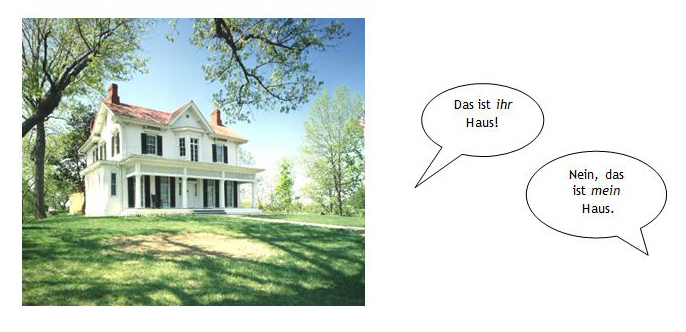
There are many considerations to think of when choosing the proper possesive article to use alongside a German noun. Take into account, as discussed in Day 15, German nouns have gender: der (Maskulinum); die (Femininum); und das(Neutrum). For the plural form, the article die is used. As for me, the rule I follow is: Know the pronoun to be used, and then the gender of the noun. We only add -e if using die whether singular or plural. Below is a table of Personalpronomen und Possessivartikel.
Personalpronomen | Possessiv-artikel | ||||
Singular | Plural | ||||
der | das | die | die | ||
ich | my/mine | mein | mein | meine | meine |
du | your (s., inf.) | dein | dein | deine | deine |
er | his | sein | sein | seine | seine |
es | its | sein | sein | seine | seine |
sie | her | ihr | ihr | ihre | ihre |
wir | our | unser | unser | unsere | unsere |
ihr | your (pl., inf) | euer | euer | eure | eure |
sie | their | ihr | ihr | ihre | ihre |
Sie | Your (f.) | Ihr | Ihr | Ihre | Ihre |
Dienstag, Januar 11, 2011
Day 24. Menschen und Haüser
Today, we began with Chapter 4, Menschen und Haüser.
Nomen singular (plural)
die Altbauwohnung (die Altbauwohnungen) = old apartments
das Bauernhaus (die Bauernhaüser) = farmhouse
das Einfamilienhaus (die Einfamilienhaüser) = family house
der Garten (die Gärten) = garden
das Hochhaus (die Hochhaüser) = high house
das Studentenwohnheim (die Studentenwohnheimen) = school dormitory
das Zimmer (die Zimmer) = room
der Mann (die Männer) = husband
die Frau (die Frauen) = wife
das Kind (die Kinder) = child
Adjektive
alt, neu = old, new
dunkel, hell = dark, bright
groß, klein = big, small
ruhig, laut = quiet, noisy
beide = both
ziemlich = quite
alt, neu = old, new
dunkel, hell = dark, bright
groß, klein = big, small
ruhig, laut = quiet, noisy
beide = both
ziemlich = quite
✎ Aufgabe 1: Wohnen in Deutschland (Seite 58)
1. Norbert Kranz, 43, und Antje van Hecke, 33, kommen aus Köln. Ihre Wohnung im 12. Stock ist hell und groß. Sie kostet 800 Euro. Das finden Norbert und Antje teuer.
2. Petra Galle, 39 und ihr Mann Guido, 41, wohnen in Olpe. Sie haben zwei Kinder: Tim, 9, und Annika, 7 Jahre alt. Sie haben ein Haus mit Garden. Petra findet: „Unser Garten ist groß.“
3. Ulli Venitzelos, 49, und seine Kinder Rolf, 22, und Simone, 17, haben eine Altbauwohnung in Hamburg. Sie leben gern in der Stadt.
4. Anja Jungbluth, 24, hat ein Zimmer im Studenwohnheim. Das Zimmer ist 14 m2 groß. Anja findet ihr Zimmer sehr Klein.
5. Bruno und Heidi, beide 71, wohnen auf dem Land. Ihr Haus ist ziemlich alt. Sie sagen: „Unser Haus liegt sehr ruhig.“
Abonnieren
Posts (Atom)